- 纳入 108 例经 VHL 改变和/或 3p 缺失分子验证的 CCRCC(原发与转移各 54),复核 CA9、KER7、PAX8、CD10 与构型分级。
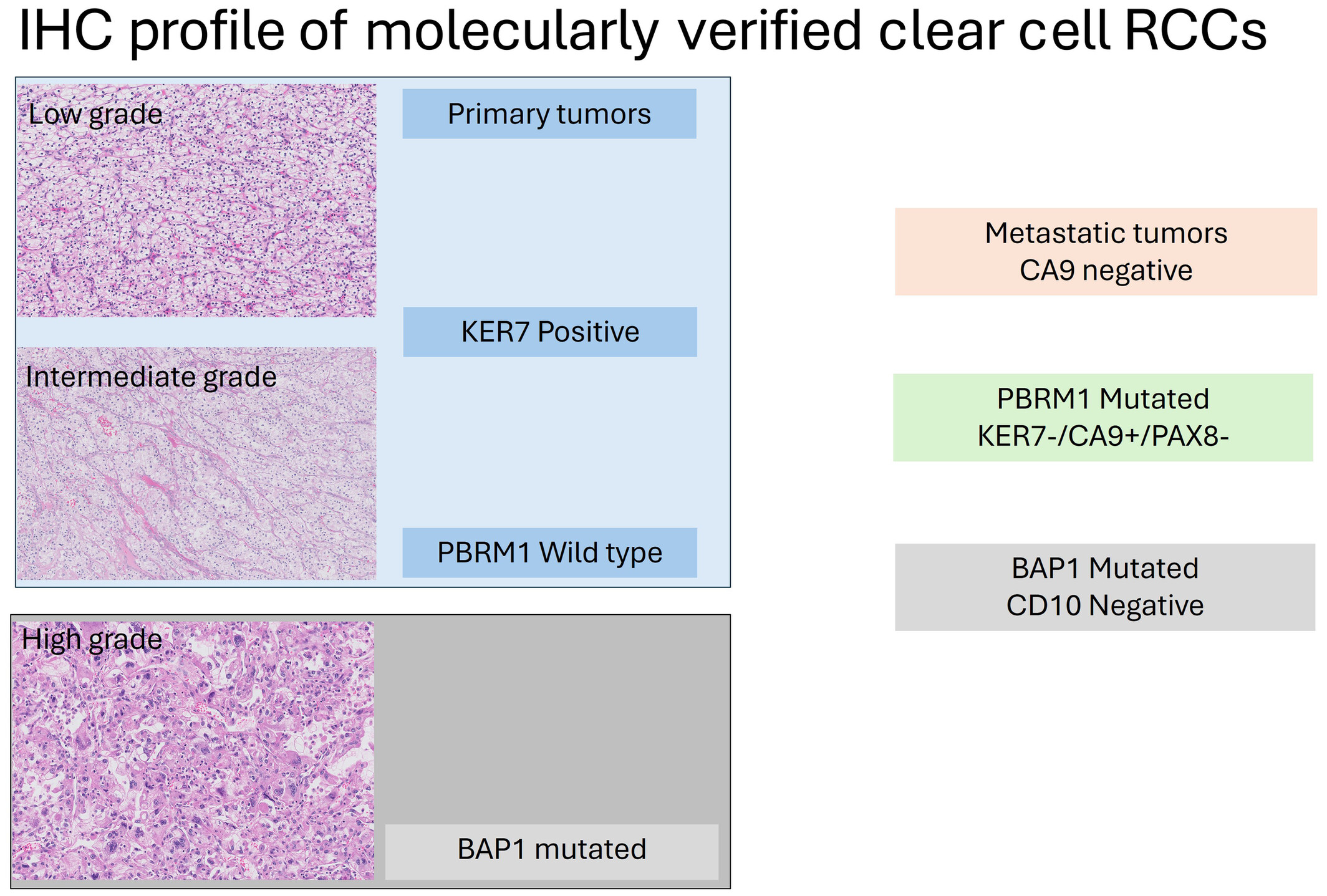
- KER7 阳性见于 30%(弥漫强阳 16%),更多见于原发灶、低/中级别构型及 PBRM1 野生型;CA9 阴性仅见于转移灶(15%)。
- PBRM1 突变更常呈 KER7−/CA9+/PAX8−;BAP1 突变更常伴高级别构型并缺乏 CD10。
收录范围:仅 PubMed 英文摘要及中文翻译(abstract-only);Wiley 全文闭源(Chrome 确认 access=no)。配图为 Wiley 目录/摘要页公开 TOC 图。
摘要
透明细胞肾细胞癌(CCRCC)的免疫组织化学(IHC)特征历来多基于形态学入选的肿瘤加以界定,但可混淆诊断的异常染色模式并不少见。近期研究已描述 CCRCC 构型模式的预后意义,并提出基于形态学的分级方案。我们对一组经分子验证的 CCRCC 队列评估其 IHC 谱,并与构型模式及关键驱动分子改变进行关联。
2015 年 1 月至 2024 年 6 月间在本机构以 NGS 检测的肾细胞癌(RCC)经复核,依据 VHL 改变和/或 3p 缺失确定 CCRCC。构型模式按近期研究分为低级别(LG:巢状、囊性)、中级别(IG:管状、管乳头状、肺泡样)及高级别(HG:融合巢/实性片状、横纹肌样、肉瘤样、低级别梭形、多形性肿瘤巨细胞),并以最高级别构型计分。复核 CA9、KER7、PAX8、CD10 的染色比例(局灶 ≤25%、中等 26%–50%、弥漫 >50%)。分析异常染色与原发/转移状态、构型模式及分子改变的相关性。
共识别 125 例分子验证 CCRCC,其中 108 例有并行 IHC 并符合纳入标准,包括原发与转移各 54 例。KER7 阳性在原发灶较转移灶更常见(45% vs 13%,P=0.001),在 LG/IG 构型中更常见(LG 67%、IG 67% vs HG 17%,P=0.002),并在 PBRM1 野生型肿瘤中更常见(PBRM1 WT 84% vs PBRM1 突变 16%,P=0.021)。CA9 阴性仅见于转移灶(15%)。PBRM1 突变肿瘤更常呈 KER7−/CA9+/PAX8−,而 BAP1 突变肿瘤更常具有高级别构型并缺乏 CD10 表达。
在该分子验证 CCRCC 队列中,KER7 阳性见于 30% 的肿瘤,其中弥漫强阳占 16%。IHC 谱与形态学特征及基因改变均相关。
- 108 molecularly verified CCRCCs (VHL alteration and/or 3p loss; 54 primary, 54 metastatic) were reviewed for CA9, KER7, PAX8, and CD10 versus architectural grade.
- KER7 positivity was seen in 30% (diffuse strong in 16%), more often in primaries, low/intermediate-grade patterns, and PBRM1-wild-type tumors; CA9 negativity occurred only in metastases (15%).
- PBRM1-mutated tumors more often showed KER7−/CA9+/PAX8−; BAP1-mutated tumors more often had higher-grade architecture and lacked CD10.
Scope: PubMed abstract only; Wiley full text is closed (Chrome confirmed access=no). Image is the public Wiley TOC/abstract thumbnail.
Abstract
Immunohistochemical (IHC) features of clear cell renal cell carcinomas (CCRCC) have historically been defined by morphologically selected tumours, but aberrant staining patterns that may confound the diagnosis are common. Recent studies have described the prognostic significance of architectural patterns in CCRCC and have proposed grading schemes based on morphology. We investigate a cohort of molecularly verified CCRCC to evaluate their IHC profiles and correlate with architectural patterns and key driver molecular alterations.
Renal cell carcinomas (RCCs) sequenced at our institution between January 2015 and June 2024 by NGS assay were reviewed to identify CCRCCs based on VHL alterations and/or 3p loss. Architectural patterns were classified into low grade (LG) (nested, cystic), intermediate grade (IG) (tubular, tubulopapillary, alveolar), and high grade (HG) (fused nests/solid sheets, rhabdoid, sarcomatoid, low-grade spindled, pleomorphic tumour giant cells), based on findings from recent studies and scored based on highest-grade pattern. IHC staining for CA9, KER7, PAX8, and CD10 were reviewed for percent staining (focal 25% or less, moderate 26%-50%, diffuse greater than 50%). Correlation of aberrant staining with primary/metastatic status, architectural patterns, and molecular alterations was analysed.
125 cases of molecularly verified CCRCC were identified and 108 cases with concurrent IHC met inclusion criteria, including 54 primary and 54 metastatic tumours. KER7 positivity was more common in primary vs. metastatic tumours (45% vs. 13%, P = 0.001), in tumours with LG/IG architectural patterns (67% LG and 67% IG vs. 17% HG, P = 0.002) and in PBRM1 wild type (WT) tumours (84% PBRM1 WT vs. 16% PBRM1 mutated, P = 0.021). Negative CA9 staining occurred only in metastatic tumours (15%). PBRM1 mutated tumours were more likely to be KER7-/CA9+/PAX8-, while BAP1 mutated tumours were more likely to have higher-grade architectural patterns and lack CD10 expression.
In this cohort of molecularly verified CCRCCS, positive KER7 staining was seen in 30% of tumours with diffuse strong staining in 16%. The IHC profiles correlated with both morphological features and genetic alterations.